
Why Treating the Spine One Structure at a Time Is Not a Treatment Plan?
Most patients with chronic back pain have a procedure history. They do not have a treatment plan.
The difference matters. A procedure history is a list of things that were done. An epidural for leg pain in March. A facet injection for local back pain six months later. A sacroiliac joint injection the following year. A Radiofrequency Ablation (RFA) along the way. Possibly a course of physical therapy that helped briefly and then stopped helping. Each step was logical in isolation. None of them were connected to the others by a single, unifying assessment of how the spine was actually functioning as a mechanical system.
A treatment plan is different. It begins by asking why the spine is producing pain in the first place. It identifies which structures are driving the dysfunction, which are reacting to it, and what mechanical chain has formed between them. It addresses the chain, not just the loudest link in it.
When patients tell me their back pain keeps coming back after multiple injections, the issue is rarely that the injections were placed poorly. The issue is that no one ever stepped back from the individual procedure decision and asked the larger question: what is the spine doing, and why is it failing to respond?
The Premise That Underwrites Fragmented Care
The spine is frequently treated as if it were modular. The disc, the facet joint, the sacroiliac joint, the muscle that hurts when palpated. Each is assigned an injection. Each is evaluated for whether it responded. The patient is moved through this sequence one structure at a time, with the implicit assumption that finding the right target will eventually solve the pain.
This is not how the spine functions.
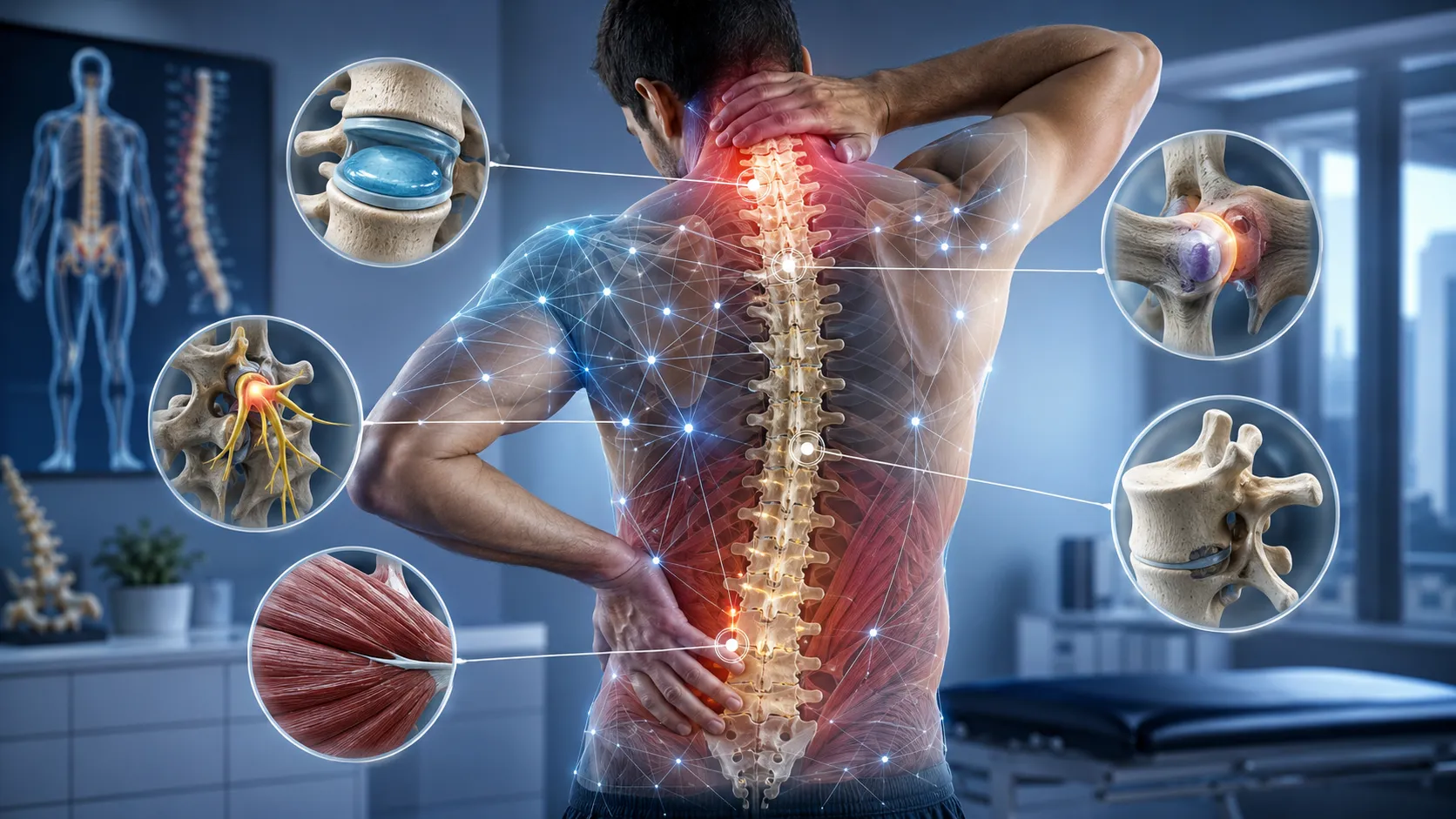
Each spinal level operates as a coordinated motion segment in which the disc, facet joints, ligaments, paraspinal stabilizers, fascia, and adjacent pelvic mechanics share load continuously. When one structure becomes painful or mechanically inefficient, the surrounding structures begin compensating within days. By the time a patient present for evaluation months or years into a chronic pain pattern, the compensatory adaptations are no longer secondary. They have become primary drivers in their own right.
This is why the loudest pain generator at the time of any given visit is often not the original problem. It is the structure that has been forced to absorb the longest period of compensation. Treating it produces brief relief while the underlying mechanical chain continues to load it. The pain returns. A new structure becomes the loudest. The cycle repeats.
What the Functional Spinal Unit Actually Includes
The functional spinal unit is not a marketing phrase. It is a mechanical description of how the spine actually works. Treating the spine through this framework means evaluating every structure that contributes to segmental load, motion, and stability, not just the structure that hurts most this week.
The intervertebral disc
The disc maintains spacing between vertebrae, absorbs compressive load, and permits multi-directional motion. When it loses height, becomes internally disrupted, or develops annular pathology, the entire mechanical geometry of that spinal level changes. The facets bear more load. The neural foramina narrow. The ligaments slacken. Paraspinal muscles guard. A disc problem is never just a disc problem by the time it becomes symptomatic.
The facet joints
Facet joints guide extension, rotation, and lateral bending. They are obligatory load-sharers with the disc. When disc height drops, the facets compress. When the disc bulges, the facets distract. Facet pain that responds briefly to injection and returns predictably is almost always a structure absorbing mechanical consequence from something else, not an isolated primary problem.
The sacroiliac joint
The sacroiliac joint transmits load between the spine and the lower extremities. It is exquisitely sensitive to lumbar dysfunction above and hip dysfunction below. Patients who are told they have an SI joint problem often have a lumbar segmental problem driving the SI joint into a position where it cannot maintain its normal load-transfer mechanics. Injecting the SI joint without addressing what is loading it asymmetrically produces predictable, repeatable, short-lived relief.
The spinal ligaments
Ligaments are the passive stabilizers of the spine. They check excessive motion and contribute to segmental control during loading. When ligaments become incompetent, the spine loses passive stability. The muscular system attempts to compensate by maintaining higher baseline tone. Patients describe this as tightness, spasm, or the sensation that their back is going to give out. This is a ligament problem presenting as a muscle problem. It will not resolve with muscle treatment alone.
The paraspinal musculature
The paraspinal system includes the superficial muscles patients can identify and palpate, and the deep segmental stabilizers they cannot. The deep stabilizers control individual spinal levels. When they inhibit or fatigue, segmental control is lost, and the larger superficial muscles take over a job they were not designed to do. Trigger point injections into the superficial muscles in this scenario address the symptom, not the cause.
The stabilizing fascia
Fascial restriction maintains tension across the lumbopelvic and thoracolumbar regions long after acute pain has settled. Patients describe diffuse stiffness, the sensation of being unable to fully decompress, and pain patterns that do not localize cleanly to any one structure. Fascia is rarely included in standard spine care because it is harder to image and harder to inject. That does not make it less mechanically relevant.
The Anatomy of a Procedure History Without a Plan
I see this pattern weekly. A patient arrives with a folder. The folder contains imaging, procedure reports, and records of treatments tried over a period of years. The pain has migrated. The patient has been told different things by different physicians, each accurate within the scope of what was evaluated. No physician was wrong, exactly. No physician asked the larger question.
The questions a complete evaluation should have answered, and typically did not, include:
- Is the disc driving the segmental load pattern, or responding to instability above or below it?
- Are the facet joints painful because of intrinsic degeneration, or because they are absorbing load the disc and ligaments are no longer carrying?
- Is the sacroiliac joint the source of dysfunction, or a downstream casualty of asymmetric loading from the lumbar spine and hips?
- Are the spinal ligaments contributing to instability that no injection can correct on its own?
- Are the paraspinal stabilizers offline, and if so, what triggered that and how is it being maintained?
- Is fascial restriction holding the system in a high-tension state that prevents recovery between flares?
- How are hip mobility, gait mechanics, and lower-extremity load patterns feeding the lumbar problem?
- What did prior corticosteroid injections do to the local tissue environment, and how does that affect what should be done next?
When these questions are answered together, a treatment plan emerges. When they are answered one at a time over years, what emerges is a procedure history.
Why a Single Injection Is Not the Problem?
Spine injections are not the issue. Image-guided injections placed accurately into appropriate targets are a clinically valuable tool. The issue is what the injection is being asked to do.
When an injection is the entire treatment plan, it is being asked to resolve a mechanical chain by addressing one link in it. That is a structural mismatch between the intervention and the problem. The injection performs the function it was designed to perform. It cannot perform the function the treatment plan failed to design.
When an injection is part of a coordinated plan that addresses the mechanical chain, the load environment, the patient’s segmental stability, and the systemic factors affecting tissue recovery, it produces a different outcome. The injection is doing what it can do. The plan is doing what the injection cannot.
What a Complete Spine Evaluation Looks Like
I am Dr. Tammy J. Penhollow, DO. I am dual board-certified in Anesthesiology and Pain Medicine, Stanford fellowship-trained in interventional spine and pain, and I have practiced exclusively in cash-pay regenerative spine and joint medicine since 2015. I founded Precision Regenerative Medicine™ in Scottsdale, Arizona in 2018. I do not use corticosteroids in my practice. I do not perform blind injections. Every procedure is performed under fluoroscopic or ultrasound guidance, and every patient receives an evaluation built around the functional spinal unit before any intervention is discussed.
That evaluation includes:
- A complete pain and procedure history, including what was injected, where, by whom, how long the relief lasted, and whether that relief shortened with repeated treatment
- Imaging correlation across the full spine, not just the currently symptomatic level, including disc height, facet arthropathy, foraminal anatomy, alignment, and segmental stability
- Positional and activity reproduction: which positions, loads, and movements provoke pain, and which structures are anatomically consistent with that reproduction
- Segmental stability assessment, including ligamentous integrity and deep stabilizer activation
- Sacroiliac joint and pelvic load-transfer mechanics
- Hip range, gait pattern, and lower-extremity mechanical contribution to the lumbar problem
- Metabolic, hormonal, and systemic factors that affect tissue healing capacity and the biological environment in which any regenerative intervention will be working
- A treatment plan that addresses the mechanical chain, not just the loudest link
When regenerative intervention is appropriate, options at Precision Regenerative Medicine™ include image-guided PRP and bone marrow aspirate concentrate delivered to facet joints, sacroiliac joints, spinal ligaments, and paraspinal soft tissue targets, sequenced with mechanical and stability work to support the biology. Procedures are autologous. No corticosteroids. No blind technique.
This integrated approach is delivered through the Tower of Power Spine® system, the clinical framework I developed for treating the spine as a single mechanical and biological unit. Tower of Power Spine® addresses segmental stability, neuromuscular control, central pain processing, and nutritional optimization alongside any biologic intervention. The biology and the mechanics are not separated. They are sequenced together as one system.
Frequently Asked Questions
Why does back pain keep returning after injections?
Because the injection addressed one structure within a mechanical chain that continues to load that same structure after the medication or biologic wears off. The injection performed correctly. The plan did not address the chain.
Why would a spine injection produce relief and then stop working?
Short-lived relief that diminishes with repeat injections is one of the most reliable clinical indicators that the targeted structure is responding to mechanical input from elsewhere in the spine, pelvis, or lower extremities. The structure is not the source. It is the casualty.
What is the functional spinal unit?
The functional spinal unit is the disc, facet joints, ligaments, paraspinal stabilizers, fascia, and sacroiliac joint considered as a single integrated mechanical system. Evaluating and treating the spine at this level, rather than as a list of separable injection targets, is the standard at Precision Regenerative Medicine™.
Is PRP used for spine pain?
PRP and bone marrow aspirate concentrate may be appropriate for selected spinal pain patterns after a complete functional spinal unit evaluation has identified specific tissue targets and confirmed that biologic intervention fits the mechanical and metabolic picture. Candidacy is not determined by chronicity alone.
What makes a regenerative spine evaluation different from a standard pain management visit?
A standard pain management visit typically identifies the most painful structure and recommends a procedure directed at it. A regenerative spine evaluation at Precision Regenerative Medicine™ identifies the mechanical chain in which that structure participates and recommends a plan that addresses the chain. The distinction is the difference between treating where the pain is loudest and treating why the pain is occurring.
What Patients Are Actually Looking For
Patients who have been through years of fragmented spine care do not usually need another injection. They need someone to step back, look at the full picture, and tell them what is actually happening to their spine and why nothing they have tried has produced lasting change.
That is the work. The injection, when one is appropriate, comes after the work. Reversing that order is what produces procedure histories instead of treatment plans.
Patients in Scottsdale and across Arizona who have been through repeated spine procedures without a unifying clinical framework, or who want to understand the whole picture before beginning any intervention, are evaluated at Precision Regenerative Medicine™ on this basis. The functional spinal unit is the unit of analysis. The mechanical chain is the unit of treatment.
To request a consultation, complete the contact form at precisionmedprp.com/contactus/ and Dr. Penhollow’s office will follow up with you directly.