Is PRP the Right Treatment for Your Knee, Shoulder, or Back Pain in Scottsdale?
When patients come to me asking about platelet-rich plasma therapy in Scottsdale, they usually arrive with one of two stories. Either they’ve done physical therapy, tried cortisone, waited it out, and are still in pain, or they’ve done their research early, decided they don’t want to go down that road, and want to know if there’s a smarter first step. Both of those paths lead to the same conversation in my office: whether PRP is actually the right tool for what’s driving their pain, and if so, how to do it in a way that gives it a real chance to work.
That second part – how to do it correctly – is where most PRP experiences fall short. Not because PRP doesn’t work, but because dose, target selection, and precision matter enormously. A treatment that draws a small volume of blood, spins it once, and injects it without imaging guidance into a joint that may not even be the primary pain generator is not the same procedure I perform. Understanding that difference is the first step in deciding whether this is right for you.
What PRP Actually Does
Platelet-rich plasma therapy explained
PRP starts with your own blood. I draw a specific volume: in my practice, a minimum of 60cc and often 120cc or more, depending on your baseline platelet count and the number of structures we need to treat, and process it to concentrate the platelets well above their normal level in your bloodstream. Those concentrated platelets are a delivery vehicle for growth factors, anti-inflammatory mediators, and cytokines that signal healing in injured tissue.
The reason volume matters is straightforward: the published evidence points to an absolute platelet count NOT JUST A CONCENTRATION as the threshold for meaningful clinical effect. A 2021 randomized controlled trial published in Scientific Reports by Bansal et al. demonstrated that a dose of 10 billion platelets was associated with sustained chondroprotective benefit in moderate knee osteoarthritis at one year, significantly outperforming hyaluronic acid at every follow-up interval beyond the first month. That number doesn’t come from a small draw. And your baseline bloodwork matters: a patient with a platelet count of 175,000 per microliter needs a meaningfully larger draw to reach that same therapeutic threshold as someone starting at 310,000. This is why I don’t have a single protocol. I have a process that starts with your individual biology.
Why patients start asking about it
Most people investigating platelet-rich plasma therapy in Scottsdale are looking for something that doesn’t just quiet the pain temporarily, they want to address what’s actually wrong. PRP is an Orthobiologic treatment, meaning it works with your body’s own biology rather than suppressing it. For joint pain, tendon injuries, and soft tissue problems, it’s often the most logical next step when the diagnosis is accurate and the treatment is executed precisely.
Some patients find me after cortisone injections that worked for a while and then stopped. Others come in before trying anything, having decided they want a regenerative approach from the beginning. What I tell both groups is the same: your outcome depends far more on the accuracy of your diagnosis and the precision of your treatment than on which path brought you here.
When PRP May Help
PRP for knee arthritis in Scottsdale
The knee is the most studied joint in the PRP literature, and for good reason; it carries enormous load and is structurally complex. When I evaluate a patient for PRP for knee arthritis in Scottsdale, I’m not simply asking where it hurts. I’m asking which structures are generating that pain, because the knee is not a single target.
In many cases, I treat what I think of as the functional unit. That may mean the intra-articular joint space, but it may also mean the medial or lateral meniscus, the MCL or LCL, the pes anserine bursa, or some combination of these. Each of those targets requires its own precisely guided injection. This is why I draw more blood than patients often expect, because the number of therapeutic targets determines how much PRP I need to produce an adequate platelet dose at each one.
PRP for knee arthritis may be worth a serious conversation when:
- Pain limits activities like walking, stair climbing, or standing for extended periods
- Imaging shows mild to moderate joint changes without end-stage structural loss
- Meniscus irritation or soft tissue involvement is part of the picture
- Swelling keeps returning without a clear acute cause
- You want a biologically driven approach before considering more invasive options
Shoulder pain relief in Scottsdale
The shoulder is one of the most mobile joints in the body, which makes it one of the most complex to treat. When patients come to me for shoulder pain relief in Scottsdale, I apply the same functional unit approach — identifying which specific structure is the primary pain generator before any treatment decision is made.
Rotator cuff pathology, tendon irritation, and certain presentations of joint inflammation may be appropriate candidates for PRP when structural damage is not severe enough to require surgical repair and the tissue still has the biology to respond. Image guidance (ultrasound for soft tissue targets and fluoroscopy for boney targets in the shoulder) is not optional in my practice. The rotator cuff tendons and surrounding structures are not targets I approach without seeing exactly where I’m placing the injectate.
Back pain relief in Scottsdale
Back pain is where I see the most mismatched treatment in regenerative medicine. Patients are told they have back pain and offered a generic injection, without anyone identifying whether the pain is coming from a facet joint, a ligament, a disc structure, a tendon attachment, or some combination of these. For patients seeking back pain relief in Scottsdale, my approach begins with that diagnostic question, not with which biologic to reach for.
When soft tissue structures around the spine are the primary pain generators, PRP may support a healing response in chronically injured tissue in ways that cortisone cannot, because rather than suppressing the local biology, it works with it. Every spinal injection I perform is guided by fluoroscopy.
Back pain that may be worth evaluating for a regenerative approach includes:
- Chronic localized pain that hasn’t resolved with appropriate conservative care
- Pain tied to ligament or tendon pathology rather than significant nerve compression
- Facet-mediated pain in appropriate candidates
- Persistent pain that continues despite prior treatments that addressed structure but not biology
Who May Be a Good Candidate
Candidacy depends entirely on what I find when I examine you, not on a checklist completed online. That said, patients who tend to be reasonable candidates share some common features: their tissue injury is active but not end-stage, their pain is tied to identifiable structures, they understand that healing is measured in weeks and months rather than days, and they’re willing to engage with the recovery process rather than expecting the injection alone to do all the work.
When damage is severe, when nerve compromise dominates the clinical picture, or when structural failure requires a mechanical solution, PRP is not the right tool. I would rather be direct about that at your first visit than put you through a treatment that isn’t matched to your problem.
It’s also worth noting that PRP is not the only option I consider. Depending on what your examination and imaging reveal, the right biologic may be PRP, or it may be an advanced regenerative cell therapy derived from bone marrow or adipose tissue. That decision comes from your exam, your imaging, and your individual biology. Not from a standing protocol.
Why the examination is the foundation
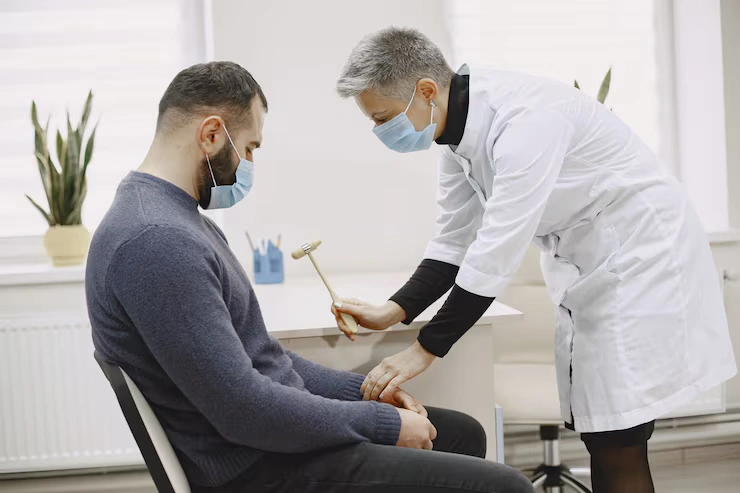
A precise diagnosis is what separates a treatment that has a real chance of working from one that’s going through the motions. When I see a patient, I review prior imaging, take a detailed history of how the pain behaves, and perform a targeted physical examination that tells me which structures to evaluate under ultrasound.
A knee that hurts on stairs is a different clinical problem than a knee that gives way on flat ground. A shoulder that wakes you at night is a different problem than one that only hurts at end-range overhead. A back that tightens after sitting is a different problem than one that sends pain down the leg. Every one of those distinctions changes the treatment plan. The diagnosis leads. Always.
What the Visit May Look Like
A precision process
A visit at Precision Regenerative Medicine™ is more structured than most patients expect, particularly if they’ve had PRP elsewhere. We’re not drawing blood, spinning it once, and injecting it into a general area. Every step is deliberate.
I review your history and any prior imaging. I perform a targeted physical examination. We use diagnostic ultrasound to confirm which structures need to be addressed. Your blood draw volume is calculated based on your baseline platelet count and the number of targets we’re treating. Every injection is performed under image guidance (ultrasound for soft tissue, fluoroscopy for the spine and any intraosseous targets). There is no guessing, and there are no blind injections in my practice.
Recovery is part of the protocol
What happens after the injection matters as much as the injection itself. There’s typically a structured period of activity modification as your biology does its work, followed by a graduated return to activity that I guide based on how you’re responding. Some soreness in the days following treatment is normal; it reflects the biological process we’re trying to generate, not a complication.
Healing with PRP is not linear and is not instant. Most patients begin noticing meaningful change somewhere between four and twelve weeks, with continued improvement over several months. That timeline is part of the treatment, not a sign that something went wrong.
When PRP Is Not the Right Answer
I’ll be direct: PRP is not the right answer for everyone. If your joint has severe structural failure, if nerve compromise requires decompression, if there’s active infection, or if what you need is immediate pain relief without any recovery period, PRP is not going to serve you well. I’d rather tell you that at the beginning than after the fact.
The right question at your consultation isn’t whether PRP works. The right question is whether your specific problem matches what PRP is designed to do. I’ll give you a straight answer to that.
Frequently Asked Questions
Why does blood draw volume matter so much?
Because the evidence supporting PRP efficacy is built around absolute platelet counts, not just concentration. To reliably reach a therapeutic platelet dose across multiple treatment targets, and to account for natural variation in each patient’s baseline blood count, the draw volume has to be sufficient. A small draw may produce a preparation that looks adequate but lacks the biology to generate a meaningful tissue response.
Is image guidance really necessary?
In my practice, yes, without exception. Blind injections, meaning those placed without real-time imaging confirmation, carry meaningful rates of misplacement even in experienced hands. When we’re talking about a biologic therapy whose effect depends on precise delivery to the right tissue, misplacement is not a minor inconvenience. Ultrasound and fluoroscopy are not optional upgrades. They are how I know the treatment has a real chance of working.
How long does PRP take to work?
The biology of tissue healing doesn’t accelerate because we want faster results. Most patients notice meaningful improvement between four and twelve weeks, with continued change over several months. The timeline depends on what we’re treating, how chronic the problem is, and how consistently the recovery protocol is followed.
How many sessions will I need?
That depends on the tissue involved, the severity of the problem, and how you respond to the initial treatment. Some patients need a single session. Others need a series. I don’t make that determination until I’ve seen how your biology responds.
Can PRP help arthritis?
In appropriate candidates with mild to moderate joint changes, PRP may support symptom improvement and may help slow the progression of joint degeneration. The peer-reviewed evidence for knee osteoarthritis is the most substantial, though the same principles of adequate dose and precise delivery apply regardless of the joint. Severe arthritis with end-stage structural loss is a different conversation.
Is PRP better than cortisone?
For short-term symptom suppression, cortisone can be effective. That’s the honest answer. But effective and appropriate are not the same thing, and the distinction matters more than most patients are ever told.
The evidence on corticosteroid injections is not ambiguous. Intra-articular cortisone has been shown in multiple studies to accelerate cartilage loss and joint space narrowing in osteoarthritic joints – the very joints it’s most commonly injected into. Repeated injections into or near tendons increase the documented risk of tendon degeneration and rupture. The mechanism that produces short-term relief (suppression of the local biological environment) is the same mechanism that undermines the tissue’s ability to heal. You feel better temporarily because the biology has been quieted. The problem is that the biology you just quieted is also the biology responsible for any repair that might otherwise occur.
I’m not dismissing cortisone categorically. There are clinical situations where it has a legitimate short-term role. But if you’ve had multiple rounds and keep returning to baseline, or if you’re asking whether there’s an approach that works with your tissue rather than against it, the answer is yes. PRP is designed to support a healing response in the tissue itself. That’s a fundamentally different mechanism, and for many patients it’s a fundamentally more appropriate one.
The Standard of Care Matters as Much as the Treatment Itself
If you’re considering platelet-rich plasma therapy in Scottsdale, the most important question isn’t whether PRP works. It’s whether the clinician performing it has identified the right targets, calculated your draw volume based on your individual biology, and is placing every injection under real-time image guidance.
That’s the standard I hold myself to for every patient. Whether you’ve tried other approaches and are looking for something different, or you’re making this decision for the first time, the process is the same. We start with your diagnosis. Everything else follows from there.